





As a Chaldean-Assyrian American born at the start of the 2003 Invasion of Iraq to immigrant parents, politics has always surrounded me. I have the wry amusement of being a member of a target demographic in a swing state (Michigan). Conversely, I’m privileged to intern alongside other young adults at the Alliance 4 American Leadership (A4AL), a nonpartisan PAC working to reform foreign assistance and bring America back to the global stage. I keep living in a state of déjà vu on foreign policy: I call the isolation-intervention pendulum. It’s the sociopolitical swing between expansive intervention and calls for isolation. When the ideological movement reverses course, it often abandons prior foreign commitments, leaving societies we intervened in worse off. As a country, we need to replace this pendulum with a principled, long-term foreign policy that defends national security, the US, the global economy, and human dignity. A plan as a country that pressures our government, without resorting to reckless regime change or reflexive isolation.
The main example that comes to mind is the 2003 Invasion of Iraq. The George W. Bush administration launched the war under the alleged pretenses that Saddam Hussein possessed weapons of mass destruction and links to Al-Qaeda. The invasion created a power vacuum and led to war crimes like Abu Ghraib (the torture and abuse of prisoners by Army members), Mahmudiyah (the gang rape of a 14-year-old and the murder of her entire family), and Haditha (25 unarmed civilians of all ages and genders killed by Marines at close range).
The war grew unpopular, and the controversy and pretenses swung the pendulum away from globalism towards isolation. President Barack Obama withdrew troops in 2011, and 75% of Americans, including nearly half of Republicans, approved the decision. This caused yet another power vacuum and several genocides. This includes my ethnic group, the Shia communities (compared to ISIS, who were in Iraq’s Sunni minority sect of Islam), and the Yezidis (a Kurdish-speaking ethnoreligious group who were and are still victims of sexual slavery and undiscovered burials). These genocides, perpetrated by the Islamic State of Iraq and Syria, better known as ISIS, were fueled by sectarianism, deepened after the U.S. invasion, years of foreign intervention, and the policies of Prime Minister Nouri al‑Maliki’s post‑invasion administration.
In the 2016 Republican Primaries, Donald Trump leveraged the Iraq Invasion against Former Florida Governor Jeb Bush (related to George W. Bush) to fuel his campaign. However, this swing to isolation isn’t as clear-cut. Even though President Trump became the face of the America First agenda, known for its populist sentiments and withdrawing from foreign conflicts, he voiced support for the Iraq Invasion in 2002. Not to mention, the pendulum swinging back in favor of intervention, where the Second Trump Administration bombed Iran, captured Venezuelan President Nicolas Maduro, and seized Venezuelan oil tankers showing adjacency to the Iraq Invasion. My explanation for why the pendulum swung back is the economic gain that can’t otherwise be achieved at home, strong reactions and fears that an adversary could gain further influence, and populism, with border security and narcotics trafficking as key issues.
The pendulum repeats itself.
The US should:
Support people at home and abroad, as neither can be separated nor put into a clear-cut binary.
Defend allies from foreign adversaries who threaten our national security.
Avoid regime-change campaigns that damage our long-term credibility and global standing.
Avoid complicity and refuse to provide financial or military assistance to countries that commit or worsen global atrocities and humanitarian emergencies.
As Americans in our current economic state, I understand how helping other countries seems counterintuitive. However, the pendulum and the failure to develop a new foreign policy plan affect us as a country. Failing to implement a new plan perpetuates the status quo of ineffective leadership, allowing our foreign adversaries to win by increasing their credibility and soft power through aid and further anti-American stances toward countries in need, raising the possibility of future attacks. It affects our economy and agriculture at home and abroad; at my alma mater, Michigan State University, more than $ 20 million in funding was cut. This resulted in 47 Malawian students’ university scholarships (their only option to attend university) no longer being paid, and in effective American agricultural research on warm-climate and disease-resistant foods. This includes potatoes, where MSU, a university historically known for agriculture, was working with farmers in Bangladesh, Indonesia, Kenya, and Nigeria to prevent blight. That’s current and future jobs lost, connections and partnerships lost, and a cost in technological advancements made in America. Not achieving a new foreign policy plan costs the lives of those dying of warfare and preventable diseases that hold no borders, like COVID-19, ending in the US and pausing the world in March 2020. It causes people to leave their homeland when they otherwise wouldn’t at the cost of US resources. Specifically, for every dollar invested in conflict prevention, $16 is saved in future, more expensive humanitarian or security responses. This is despite foreign assistance making up less than 1% of federal funding.
The US needs a new foreign policy plan, not a pendulum. This pendulum has cost lives and credibility; it’s time to stop swinging a pendulum we've seen our entire lives. It’s time for a durable foreign policy framework balancing security, human rights, and multilateral cooperation.
The views expressed in this piece are those of the author and do not necessarily represent the position of the Alliance 4 American Leadership (A4AL) alone. Alliance 4 American Leadership would like to acknowledge the many generous supporters who make our work possible.
Recent Articles
Rep. Delia Ramirez Endorses A4AL's Two-Penny Pledge

Six Purely Selfish Reasons to Support USAID

The US-Iranian War: Implications for USAID and the Economy

Alliance for American Leadership Hill Day Press Conference
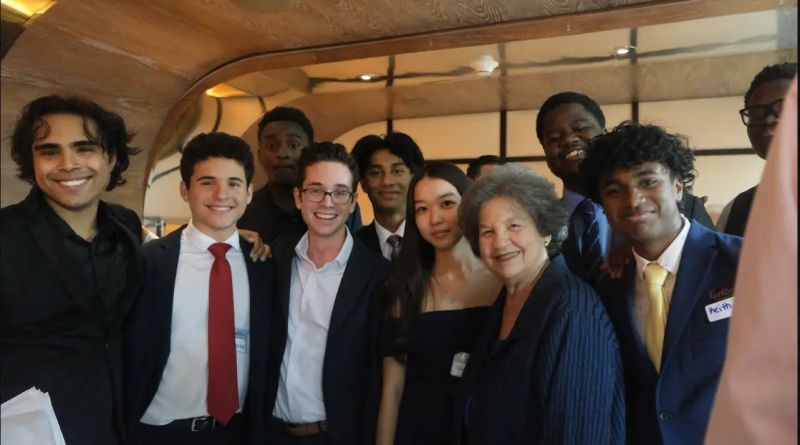
A4AL Endorses USAID Champion Representative Lois Frankel (D-FL 23)
Did You Know That the United States Spends Less Than 1% of Its Budget on Foreign Aid?
Stay Updated
Become a member to learn about our impact, events, and how to get involved.