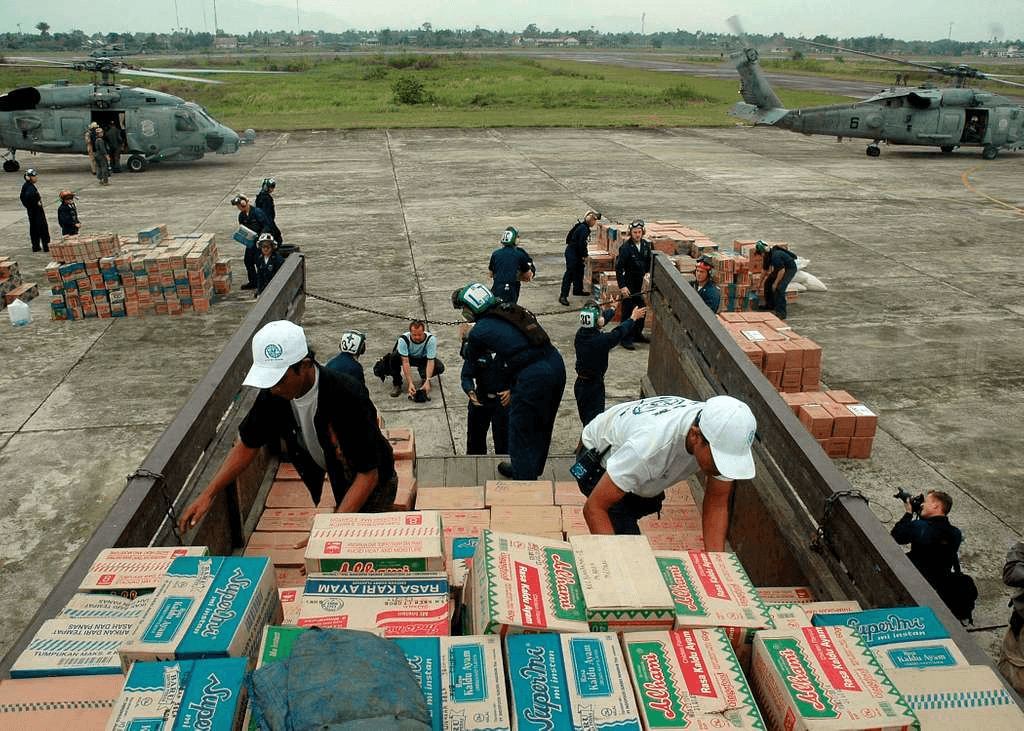




On May 25, 1961, John F. Kennedy addressed Congress with a pressing matter. Almost 15 years into the Cold War, the USSR was gaining mass amounts of influence through unnatural means. Instead of imperialism, America’s primary adversary was quietly influencing nations through humanitarian aid. Across the continent of Africa and beyond, the Soviet Union was filling the vacuum of poverty and instability. “They have fired no missiles; and their troops are seldom seen,” Kennedy observed. For the U.S, foreign aid had become a necessary vehicle of international power.
Kennedy’s words proved to be true. Researchers at Vanderbilt University have since confirmed JFK’s vision: U.S aid empirically works for spreading democratic governance and advancing American strategic interests abroad. In the years since Kennedy's address, the United States Agency for International Development (USAID) has become a beacon of humanitarianism, and Africa became one of its most consequential grounds of engagement. Over the past twenty years alone, the United States directed $131.6 billion in aid to the continent, funding HIV/AIDS treatment, malaria prevention, agricultural development, and — critically — $2.8 billion in democracy and good governance programs aimed at building durable, accountable states.
Then 2025 arrived.
Under the Trump administration, the architecture of U.S aid was dismantled with remarkable speed. Justifications of such cuts were made by pointing to isolated examples of questionable spending (i.e. transgender comic books distributed in Peru or DEI-themed musicals in Ireland). Yet, many of the specific fraud claims have been largely debunked. Even where inappropriate spending could exist, the response was wildly disproportionate. The administration ultimately cancelled 83% of all USAID foreign aid contracts. Not on the margins, but on the mission itself.
The consequences are already being counted in lives. The Center for Global Development estimates that over one million people died in 2025 alone as a direct result of the cuts. Indeed, CNN projects that figure could reach 9.4 million additional deaths by 2030, with approximately 2.5 million of those being children under the age of five. Washington needs to step outside of fantasyland policies premised on the fiction that American disengagement is consequence-free.
The scale of the damage becomes clear only when measured against what USAID actually built.
Senator Chris Coons of Delaware notes that USAID and its affiliated programs — including the President's Emergency Plan for AIDS Relief (PEPFAR) — has largely been a bipartisan effort for decades. U.S aid has drawn in consistent backing from both sides of the aisle, precisely because their results were difficult to argue with. In Nigeria alone, PEPFAR invested more than $6 billion in the national HIV/AIDS response, directly reaching over 8.2 million people through counseling and testing services. These kinds of programs were the backbone of public health infrastructure in some of the world's most vulnerable countries.
The aggregate picture is equally striking. A 2025 peer-reviewed study published in The Lancet found that over the two decades from 2002 to 2021, development assistance (concentrated heavily in Africa) was associated with a 32% reduction in child mortality under the age of five, a 65% decline in HIV/AIDS deaths, and a 51% drop in malaria mortality. This data represents how U.S aid led one of the most impactful medical turnarounds in modern public health history. Not through military intervention, but through sustained, strategic investment.
That record of achievement makes what has followed all the more consequential for both Africa and the United States.
The immediate human toll on the continent has been severe. Refugees International documents that USAID funding reductions did not occur in isolation, rather, they triggered a cascade effect. Other nations followed suit and led to an overall reduction of approximately 30% in global aid. Across 93 low- and middle-income countries, 53.3 million people have lost access to essential health services, such as immunization. Many facilities that once operated preventative health programs have now been forced into reactive, emergency-only modes. Epidemiologists regard this shift as deeply dangerous, since preventative care is exponentially more cost-effective in the long run. For example, The Education Development Center was compelled to lay off over 600 staff and cancel programs in countries including South Sudan.
The consequences do not solely affect Africa. In the end, America has the most to lose. Dr. Atul Gawande, former Assistant Administrator for Global Health at USAID, has warned that the funding cuts would effectively abolish disease surveillance networks that span more than 50+ countries. Fundamentally, these are the most crucial early-warning systems that detect and contain outbreaks before they become pandemics. Dismantling this pivotal infrastructure that monitors emerging pathogens in the regions where they most frequently originate is a tremendous risk to the American public.
While the public health argument is powerful on its own terms, the economic case against the cuts is equally compelling and bilateral.
For Africa, the projections are stark. Current modeling suggests that the USAID cuts could push 5.7 million additional Africans below the extreme poverty threshold within a year, with that figure rising to approximately 19 million by 2030. One instance of this is within Somalia. Reduced American spending has already demonstrably contracted economic activity, shrunk domestic tax revenues, and slowed overall growth. This pattern has been replicated across similar nations whose government budgets were partially structured around the expectation of continued U.S. assistance. This shows that not only was the size of the cuts to U.S aid detrimental, but the speed at which it was carried out was too. Poverty at this scale does not remain contained to the economic or regional domain. It destabilizes governments, accelerates migration, and creates the conditions of desperation that extremist organizations have historically exploited and thrived in.
For America, economic damage operates through slightly different but equally serious mechanisms. The Institute for Development Impact finds that gutting USAID places over 200,000 American jobs at risk and strips approximately $23 billion from U.S. exports. Aid programs don’t just transfer money; they build the legal environments, professional networks, and institutional relationships that allow American businesses to operate in emerging markets. Eliminating that infrastructure forfeits future market access.
Most consequentially, it forfeits that access to a waiting competitor. In absence of U.S aid, China has moved swiftly to fill the vacuum left by America, deepening its ties across the continent and introducing zero-tariff trade arrangements with African nations. Beijing's calculation is simple: relationships built today through investment and assistance translate into commercial and diplomatic leverage for decades. Kennedy understood this dynamic in 1961, and so did America. But today, that consensus has been lost, derailed all in the name of short term leverage. According to the New York Times, executives in Washington have considered conditioning aid to countries such as Zambia on their willingness to grant American firms increased access to mineral extraction. Historically, China has taken a vastly different approach. With a “no-strings attached” policy, its dealings in Africa have been inviting to authoritarianism and corruption, all in the name of resources. An Africa oriented toward Chinese investment rather than American partnership represents a strategic loss whose costs will compound long after the aid budget savings have been spent.
In 1961, John F. Kennedy argued that the struggle for the developing world would be won not by the nation with the most weapons, but by the nation most committed to the proposition that freedom and development were inseparable. He was right then, and he would be right now.
The cuts to U.S. aid to Africa are not a fair fiscal assertion of American priorities. They are a self-harming policy that harms Africa immediately and the United States over time. The public health and economical consequences do not remain in Africa. They arrive in Washington in the form of pandemic risk, strategic disadvantage, and a diminished American presence in the fastest-growing region of the world.
The question is whether the United States can afford the world that emerges when it stops showing up. On the current trajectory, Americans are being asked to find out.
The views expressed in this piece are those of the author and do not necessarily represent the position of the Alliance 4 American Leadership (A4AL) alone. Alliance 4 American Leadership would like to acknowledge the many generous supporters who make our work possible.
Recent Articles

Waning Withdrawal: How U.S. Aid Cuts Are Undermining America's Future in Africa
Reviving USAID for US National Interest Takes Center Stage at Packed Event with Rep. James Walkinshaw
Republican and Democratic Members of Congress Celebrate USAID at Packed Penn State Event

Consequences of US aid Withdrawal from ASEAN countries

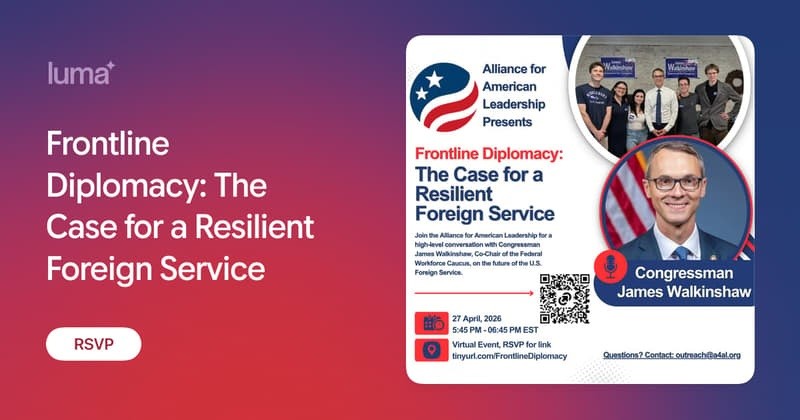
Frontline Diplomacy: The Case for a Resilient Foreign Service

Strategic Retrenchment or Strategic Risk?
Stay Updated
Become a member to learn about our impact, events, and how to get involved.