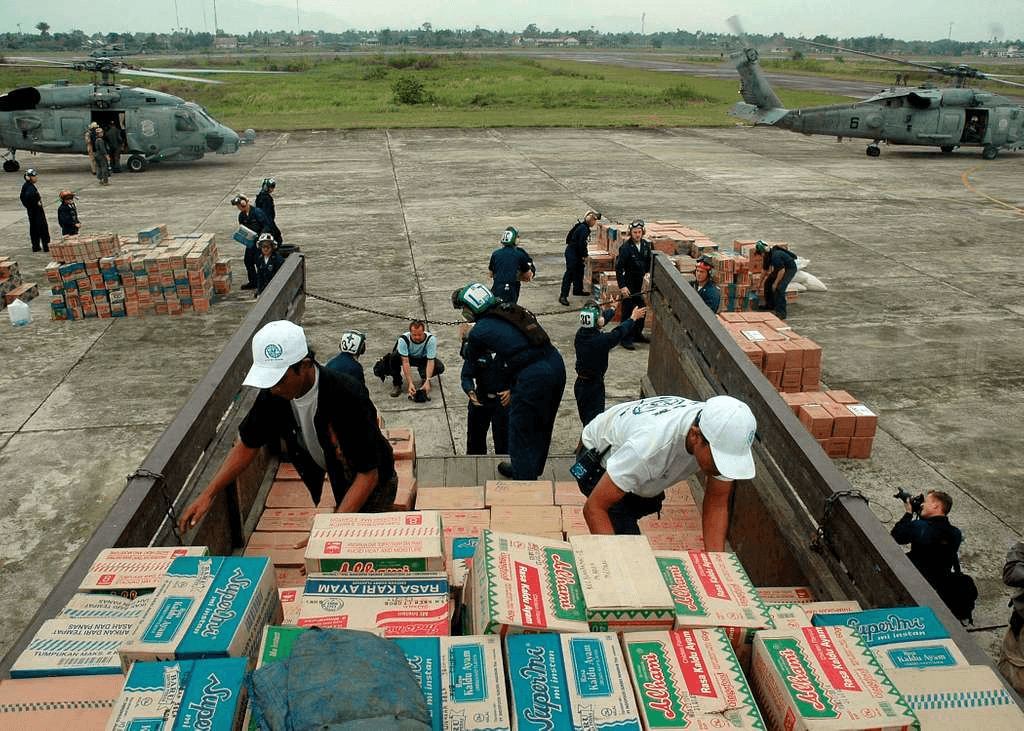





ASEAN (Association of Southeast Asian Nations) is a supranational organization whose members are among the world's fastest-growing economies, and whose territorial waters host some of the world's busiest trade routes. These nations face significant security challenges including the devastating effects of climate change, civil unrest, and encroachment into their territorial waters by Beijing in the South China Sea. Yet at this critical moment, aid from Washington to the region has dropped by more than 2 billion dollars. Significant segments of the populations in ASEAN countries already believe the group should, if forced, align with Beijing over the US. A withdrawal of aid to the region risks a soft-power surrender by Washington and encourages ASEAN nations to turn to Beijing for security and support.
Why should Washington care?
Freedom of navigation in the South China Sea guarantees safe passage for United States naval and commercial vessels, as well as those of its allies. These lucrative trade routes are valuable to the United States and essential to strategic allies such as Japan, as 40% of their exports flow through the Strait of Malacca. Furthermore, expanding economies like Vietnam’s are poised to become leading semiconductor producers, which are irreplaceable in both consumer and military applications. Relatedly, ASEAN nations are home to 47% of the world's nickel reserves and 35% of its tin reserves, both considered critical minerals. Finally, trade with ASEAN nations creates more than 625,000 US Jobs. Ensuring the stability and good will of these expanding economies is a strategic advantage to the United States.
Foreign aid is also more generally a lucrative investment for America. For every $1 invested into foreign aid, the US generates $2-$4 dollars in economic and strategic returns. While the money pulled from foreign aid will be invested elsewhere, an average 200-400% return on investment is a hard value proposition to beat.
What are the harms?
In 2025, the US cut over 2 billion dollars in aid to ASEAN countries. The humanitarian impacts of such a major divestment both have been and will be devastating. In Vietnam, Laos, and Cambodia, unexploded ordinance operations have been halted placing children at risk of life-altering injury. In war stricken Myanmar hundreds of thousands have been left without critical emergency food and medical care. Across the region, healthcare programs fighting AIDs, tuberculosis, and an ongoing malaria outbreak have been gutted. Finally, cuts to programs promoting good governance and healthy political participation will undoubtedly lead to greater instability. Put in no uncertain terms, these cuts will kill people and damage US strategic interests.
Cuts to aid put ASEAN nations in a worse bargaining position with China. Previously, South East Asian nations were taking on less and less Chinese Official Development Financing. For example, according to research from the Lowy Institute, in 2015 ASEAN nations accepted $9 billion in Chinese development financing, but by 2022, they were receiving only $3 billion in Chinese financing. The report suggests that pulling US funding could leave ASEAN nations with a painful choice, either rely more heavily on Chinese ODF to meet their infrastructure needs, or endure stunted development as deficits form in their balance sheets. Worse still, these deficits would come while China continues to expand their presence into ASEAN nations territorial waters. Considering this, the withdrawal of US aid not only impairs economic bargaining for ASEAN states, but potentially their strategic bargaining as well.
What are the costs?
These cuts come at a time when faith in the United States among ASEAN leaders is already waning. A poll from the ASEAN Studies Centre at ISEAS from 2024 indicates that if forced to choose a side between the US and China, 50.5% of respondents in ASEAN nations would prefer to side with China. This is up from 38.9% favoring China in 2023, meaning preference for the United States fell by 11.6% in one year. While this data is not yet available for 2025, considering the trend of increasing negativity towards the US globally, this shift is unlikely to reverse.
As it stands, ASEAN nations collaborate with the United States on matters of maritime security in the South China Sea. In doing so, the US can guarantee the free flow of trade, one of its core strategic priorities, and ensure the economic prosperity of export-dependent key regional allies (eg. Japan). ASEAN nations on the other hand, gain assistance in defending their territorial waters and exclusive economic zones from Chinese incursion. This declining perception of the US, though, could compound with weakening bargaining positions among ASEAN states relative to China to create strategic and economic risks for the US. While nations such as Vietnam or the Philippines will not simply turn over for Beijing if US funding dries up, a weakened bargaining position and injured trust in Washington will encourage a more conciliatory tone with Beijing. In the best cases ASEAN nations will have to think more carefully about how they balance their relationship with Beijing, and in the worst cases, they may reconsider their co-operation with US strategic objectives.
Finally, withdrawal of USAID funding and its humanitarian consequences will have economic ramifications for the United States. In a globalized economy both economic costs and gains are passed around the supply chain. So malaria outbreaks, typhoon damage, and political instability all come with economic costs not only to ASEAN economies, but to the US economy as well. For example, if the Port of Tanjung Priok in Indonesia is disabled due to a typhoon and tin exports are stopped, then US electronics companies will face rising input costs and be forced to lay off workers, or pass those costs on to US consumers. US aid spending mitigates these sorts of risks at a lower cost than accepting them, with data suggesting that every dollar of foreign aid investment saves $103 in crisis response costs.
What must be done?
The US must restore USAID contracts and reinstate the organisation. While the State Department has taken over USAID programs that were not canceled, they lack the expertise to properly facilitate them. For example, the State Department does not generally employ agricultural scientists, whose expertise is essential for USAID programs supporting efficient farming practices. By restoring USAID, the US can recoup USAID contracts and personnel in hopes of “picking up where it left off.” In order to fully restore the position of the US among ASEAN nations, USAID restoration must be paired with an expansion for foreign aid funding. This is in part simply necessary to make up for lost ground, but also to signal to ASEAN nations that the US is truly committed to their aid. By doing this we regain the faith of ASEAN nations, defend our strategic interests, and bolster the bargaining position of ASEAN states against Beijing.
The views expressed in this piece are those of the author and do not necessarily represent the position of the Alliance 4 American Leadership (A4AL) alone. Alliance 4 American Leadership would like to acknowledge the many generous supporters who make our work possible.
Recent Articles

Rep. Delia Ramirez Endorses A4AL's Two-Penny Pledge

Six Purely Selfish Reasons to Support USAID

The US-Iranian War: Implications for USAID and the Economy

Alliance for American Leadership Hill Day Press Conference

A4AL Endorses USAID Champion Representative Lois Frankel (D-FL 23)
Did You Know That the United States Spends Less Than 1% of Its Budget on Foreign Aid?
Stay Updated
Become a member to learn about our impact, events, and how to get involved.