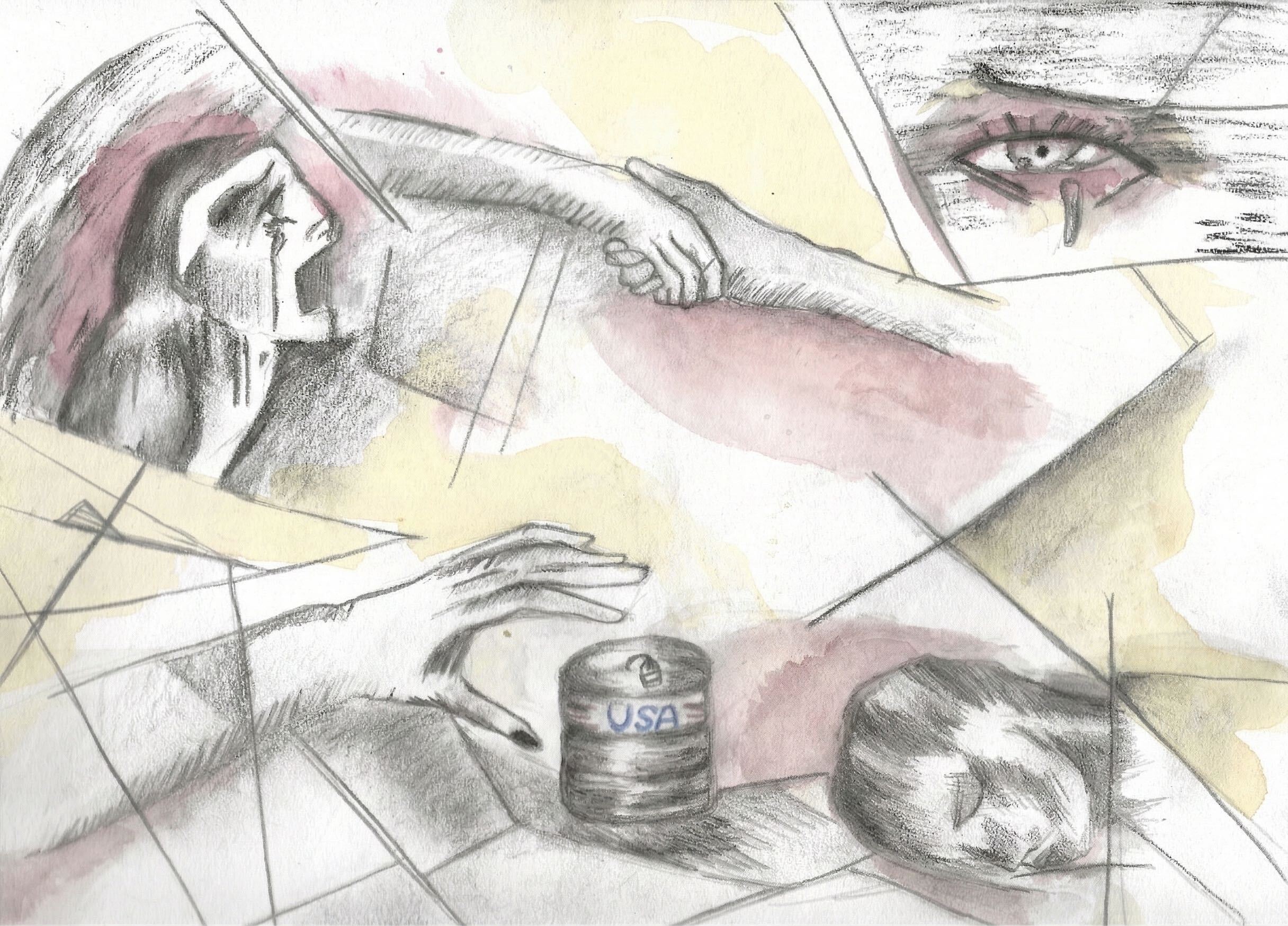





My Grandmother, Annie Kurian, had been hired by the Sisters of the Destitute, a Catholic nun's organization, as a local coordinator. Their convents across Kerala were the local implementers of a large-scale food aid program run by Catholic Relief Services, which distributed American supplies such as wheat, bulgur, oil, milk powder, and corn flour to mothers and children on behalf of USAID.
She would set out on foot through low-income neighborhoods, going house to house. Pregnant women and children under five were eligible to receive monthly supplies. Since these ingredients were unfamiliar in Kerala kitchens, my grandmother taught simple, practical recipes to families, showing them how to turn corn flour or bulgur into something they would actually want to eat. She herself had been trained by field officers from Rajagiri College of Social Sciences, social workers who had spent time figuring out how to translate these foreign commodities into locally acceptable meals that could actually raise nutrition levels.
This wasn't just charity. It was something communities depended on to stay healthy. The program ran for 20 years, and in that time, it helped a generation of children grow up rather than become casualties of malnutrition. My grandmother would sometimes cross paths with those same children years later, now adults, and they would recognize her immediately. Some offered her a free ride, others insisted she sit down and share a cup of tea. She found it deeply rewarding to watch those kids find their niche in life and flourish. It was a story that stayed with me, and somewhere in the telling of it, I knew I wanted to be a social worker like her.
I started connecting on LinkedIn with social scientists, field workers, and program officers who had worked for USAID and CRS worldwide. They turned up everywhere their programs had reached, from remote villages in sub-Saharan Africa that had been through civil war and were starting over, to communities in Asia that are still rebuilding after floods. Their stories were hard to miss. Interesting stories flooded my timeline, such as teams sleeping in tents to reach families cut off by earthquakes, and hiding during bomb threats. Aid workers stayed through epidemics when governments had already pulled out.
USAID was a leading force with hundreds of thousands of local nonprofits woven into the same fabric, doing the work on the ground. The more I read, the more I understood that what my grandmother had done in India was part of a vast, deliberately built structure.
Then, in February 2025, it all came apart. I didn't learn about the collapse of USAID from the news. I watched it unravel on LinkedIn. One day, my feed was full of program updates. The next, it was something else entirely. Shock and disbelief plagued my timeline, the kind of posts people write when they don't know what else to do. Senior officials who had spent entire careers fighting poverty and hunger announced they had been put on leave, then fired. Projects that had taken years to build were halted abruptly.
That's when Elon Musk wrote that they had spent the weekend 'feeding USAID into the wood chipper.' Every single person I had connected with, along with tens of thousands of their colleagues, was suddenly out of a job. The same LinkedIn feed that had introduced me to this vast, quiet network of people keeping the world from falling apart was now filled with termination notices, farewell posts, and halted programs.
Now, in February 2026, we mark one year since USAID was dismantled. A 60-year-old institution, erased in a matter of weeks. It was sold to the public as a way to eliminate waste, but USAID funding accounted for less than 1% of the federal budget. It was a political decision dressed up as moral responsibility. The damage such a decision created already has a body count.
In Kenya, where USAID had invested $436 million in a single year, roughly 40,000 jobs vanished overnight. In the Kakuma refugee camp, the failure to renew a $112 million World Food Program grant led to rations being at their lowest levels. In Ethiopia, nearly 16 million people had relied on donated grain in 2024, and half the country's children were already malnourished when the funding stopped.
In Afghanistan, over half the population was already facing food insecurity before the cuts. More than three million children under five were at risk of acute malnutrition. When 80% of USAID programs were canceled, the most desperate families were left with nothing.
These are not projections from a distant future. They are already happening, country by country, camp by camp, child by child. A major analysis published in The Lancet estimated that the continued termination of USAID could result in 14 million additional deaths worldwide by 2030. This includes 4.5 million children under five. Most Americans, if they knew, would be unwilling to accept responsibility for this.
Last week, Congress passed a $50.16 billion FY2026 Foreign Affairs Bill, approving $1.2 billion for Food for Peace and $720 million for Feed the Future. These funds serve as a long-overdue acknowledgment of the suffering felt across the globe during this last year of USAID’s absence. But a funding bill is not the same as an institution. Congress must ensure that the State Department and USDA will employ professionals to design and manage these programs. Rebuilding is also an opportunity to design something better and more direct.
The views expressed in this piece are those of the author and do not necessarily represent the position of the Alliance 4 American Leadership (A4AL) alone. Alliance 4 American Leadership would like to acknowledge the many generous supporters who make our work possible.
Recent Articles

Going Red, White, and Blue for USAID
Rep. Delia Ramirez Endorses A4AL's Two-Penny Pledge

Six Purely Selfish Reasons to Support USAID

The US-Iranian War: Implications for USAID and the Economy

Alliance for American Leadership Hill Day Press Conference
A4AL Endorses USAID Champion Representative Lois Frankel (D-FL 23)
Stay Updated
Become a member to learn about our impact, events, and how to get involved.