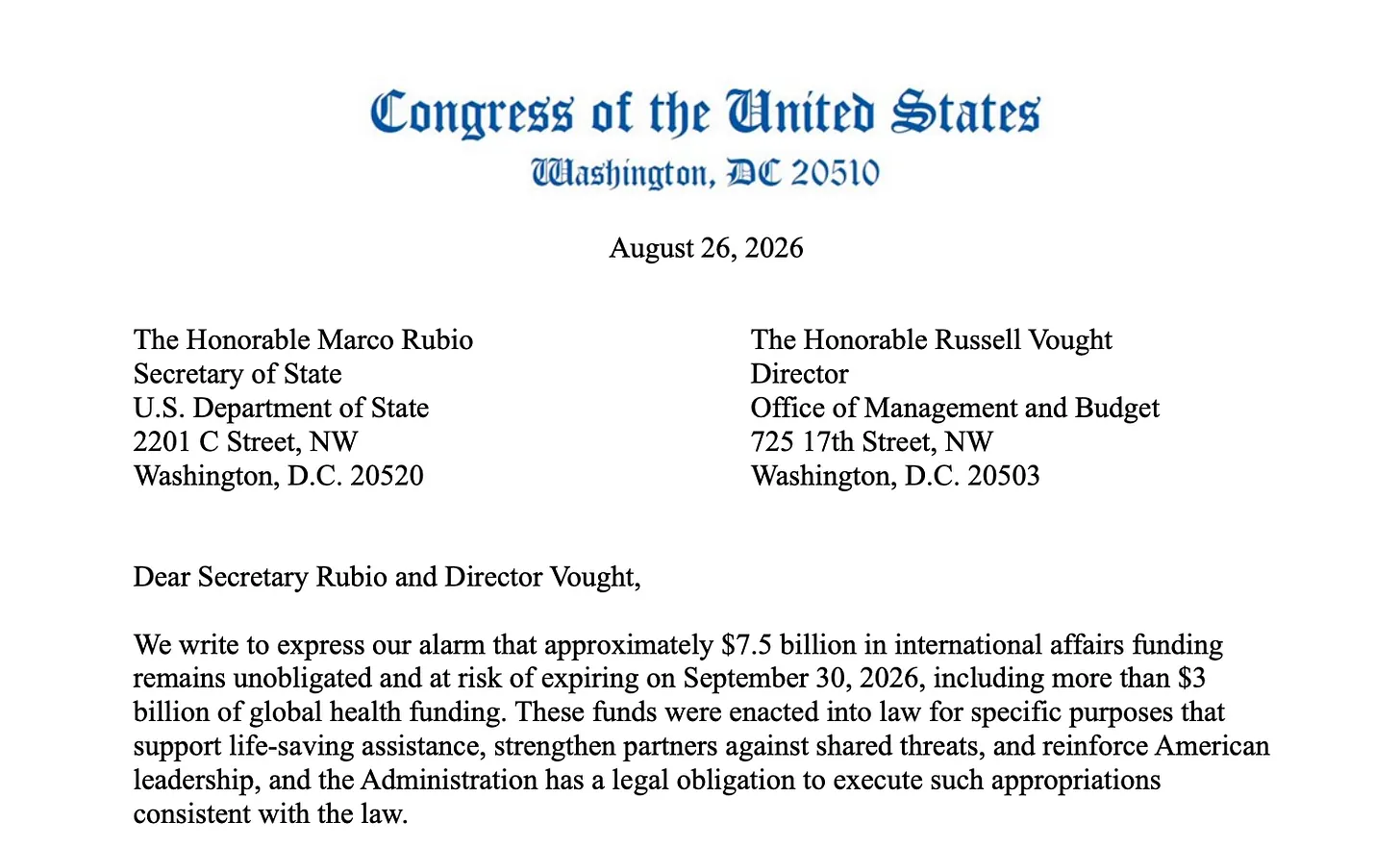





Congressman James Walkinshaw’s letter begins where foreign policy too often ends: with a date.
The date is September 30.
By then, unless the administration acts, roughly $7.5 billion in international affairs funding will expire: this is money Congress already approved for the work of protecting American interests abroad. More than $3 billion of it is tied to global health, and of that about $1.35 billion, roughly 18 percent of the total at risk, is being withheld to cover the costs of closing USAID rather than spent on the programs Congress funded. The United States has already made these commitments. They now face disappearing before the calendar turns, an administrative failure hardening into foreign policy.
The bicameral letter is led by Walkinshaw alongside Senator Ed Markey (D-MA) and Representatives Gabe Amo (D-RI) and Robin Kelly (D-IL) and joined by 134 of their colleagues. It urges Secretary of State Marco Rubio and OMB Director Russell Vought to release and obligate the funds before they expire because the funding was enacted for specific purposes: to provide lifesaving assistance, strengthen partners against shared threats, and reinforce American leadership. This is not a procedural footnote. It is a test of whether an American commitment remains a commitment.
A story like this is easy to skip over: another quarrel between Congress and an administration, full of technical details that can put the average reader to sleep, the sort of thing that matters only to people who know what “obligation” means in federal budget law.
That would be a mistake, so stay with me.
Under 31 U.S.C. § 1502, appropriations available for a definite period generally must be spent within that period or obligated by contracts properly made before it closes. The law is not a suggestion. It is the mechanism through which Congress’s decisions become public action.
When time runs out on an appropriation, the funding expires, with consequences that very much show up in the wider world.
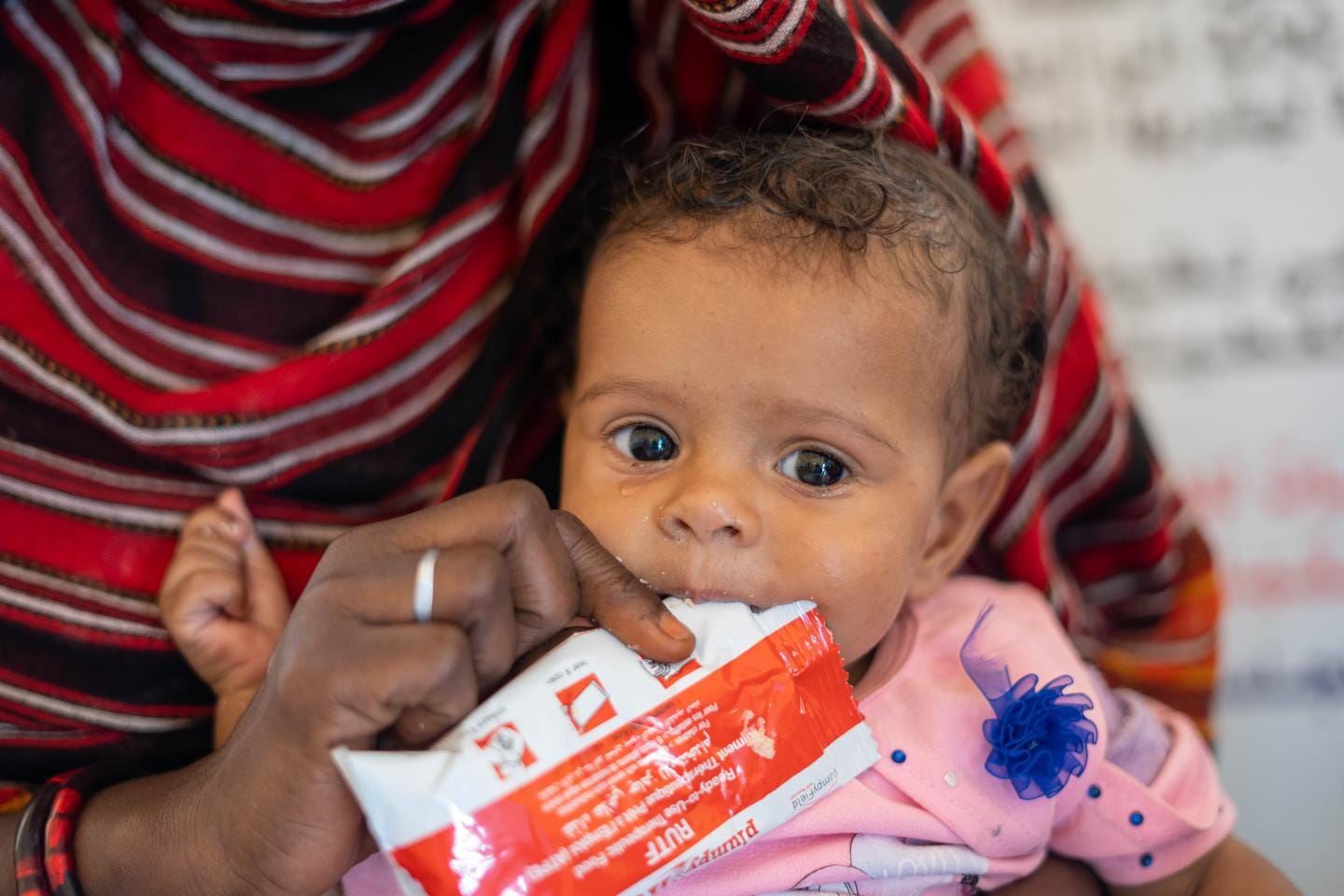
The health programs fund work on HIV/AIDS, tuberculosis, malaria, maternal and child health, malnutrition, neglected tropical diseases, and global health security. Allowing it to lapse, the lawmakers warn, could contribute to an estimated 121,000 deaths from tuberculosis and 47,600 from malaria, and cost 22.9 million children lifesaving nutrition products. Their conclusion is stark: “This hardship can be prevented if the Administration spends these funds as Congress directed.”
Without action, a health program loses the ability to plan. A humanitarian partner is left waiting. A diplomatic commitment becomes less credible. A foreign government feels betrayed by the broken promise of the United States.
And the space America vacates does not stay empty. NPR has reported that China is positioning itself for a larger presence in global health and development as the American system retreats; an analysis this year in War on the Rocks examined how China and Russia use food and development relationships to fill the openings American withdrawal creates. A Pew Research Center survey found that the most common view of U.S. influence was that it is weakening — while 62 percent of Americans said China’s is strengthening. The point is not that anyone can simply replace the United States. It is that influence erodes by increments — through delayed commitments, canceled programs, unanswered requests — and every opening is harder to close once another power has walked through it.
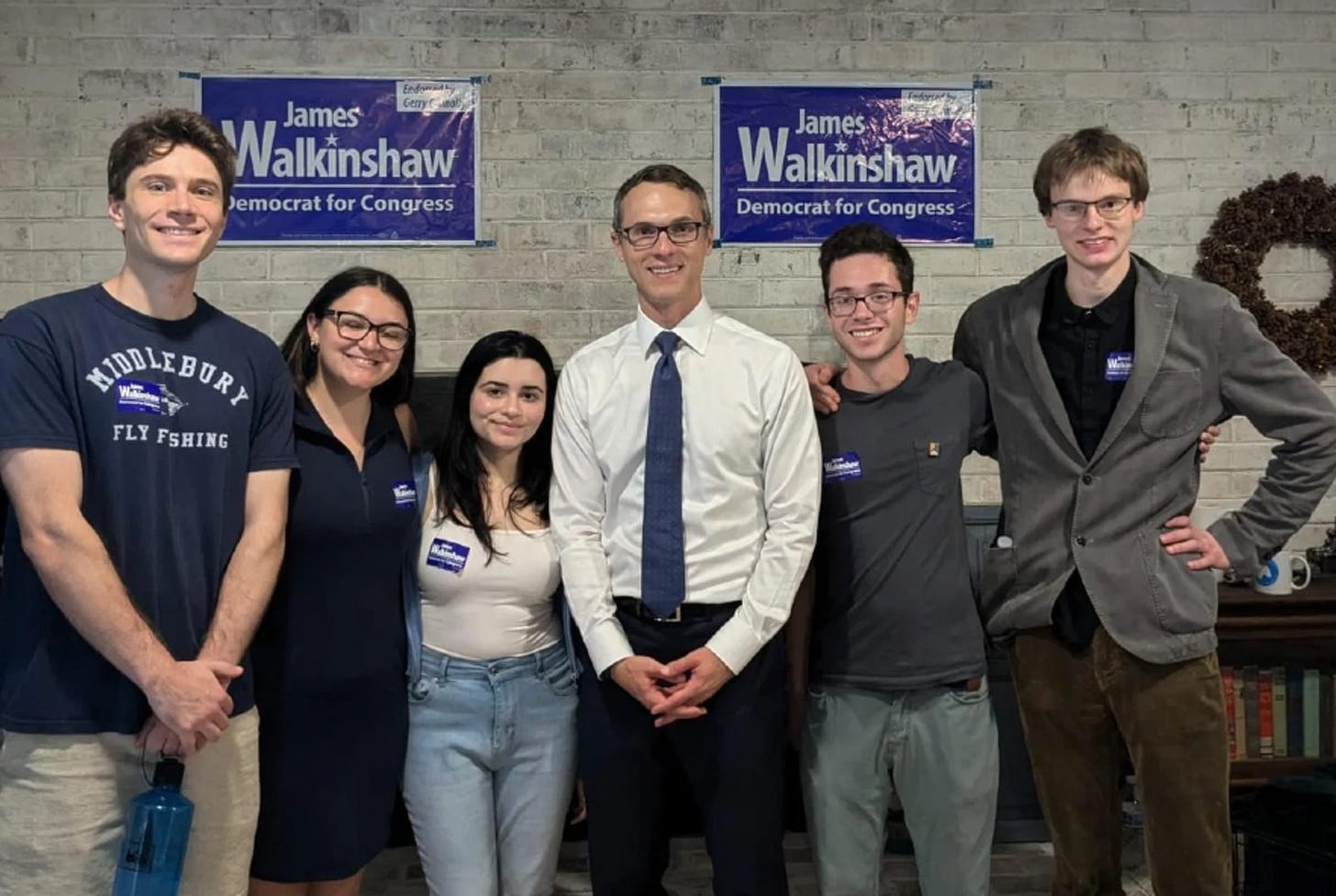
That is why Walkinshaw’s leadership matters. The Alliance for American Leadership endorsed him because he treats American leadership as a responsibility with strategic consequences, and foreign assistance not as a ceremonial gesture of goodwill, but as part of the country’s operating equipment, as necessary to American influence as diplomacy, intelligence, and defense.
None of that exempts foreign assistance from scrutiny. Public money deserves oversight. Programs should be evaluated, waste confronted, results demanded—serious support for American leadership requires serious standards. But oversight and abandonment are not the same thing. Reform and retreat are not the same thing. A country can insist on accountability without discarding the instruments through which it protects its interests.
A sum this large is not an accounting footnote. It is years of relationships, institutional knowledge, and hard-won credibility: the kind of foreign policy trust that is built through treatment continuity, disease surveillance, trusted partnerships, and the steady presence of American institutions. It is not dramatic until it disappears. Once credibility is surrendered, it cannot be restored by issuing a press release. Once a partner has reorganized its expectations around American unreliability, a later promise is discounted; once another power fills the vacuum, the vacuum does not politely reopen when the United States changes its mind.
American power has never rested on military strength alone. It depends on the confidence of other nations that the United States can organize, persuade, build, and be counted on.
The lawmakers have demanded answers by September 9 on the administration’s plan to release the remaining global-health funds. That gives the story its next act.
The deadline is approaching.
Alliance for American Leadership is a reader-supported publication. To receive new posts and support my work, consider becoming a free or paid subscriber.
The views expressed in this piece are those of the author and do not necessarily represent the position of the Alliance 4 American Leadership (A4AL) alone. Alliance 4 American Leadership would like to acknowledge the many generous supporters who make our work possible.




Stay Updated
Become a member to learn about our impact, events, and how to get involved.