The Two Penny Pledge
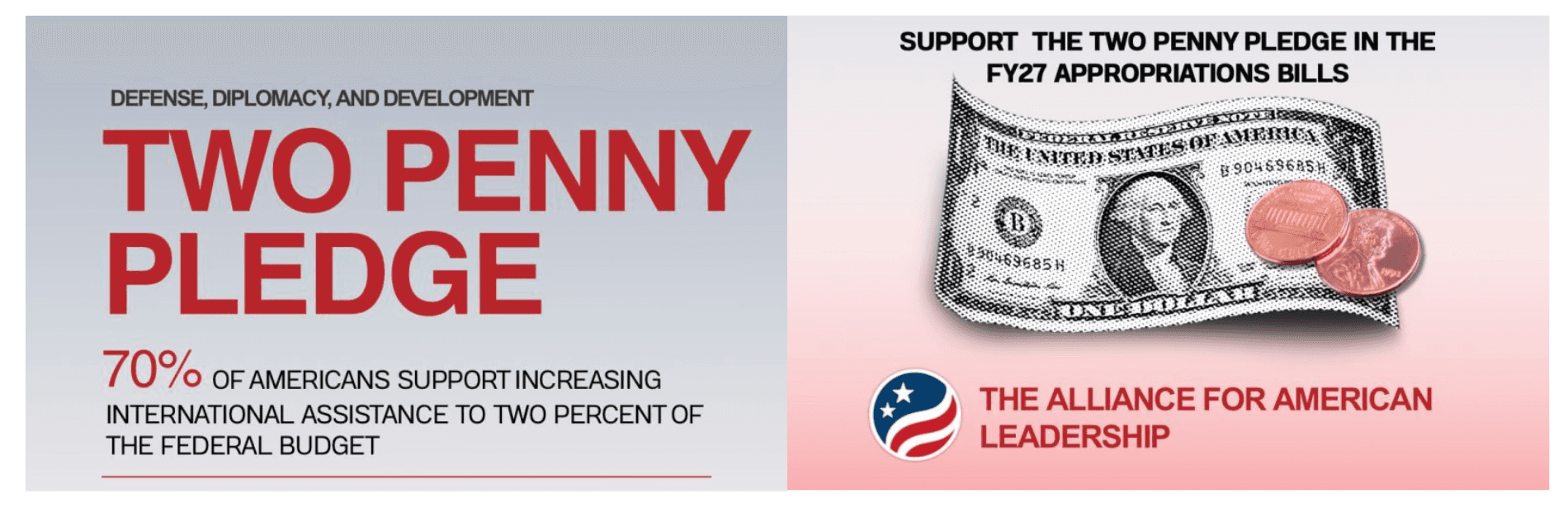
The Two Penny Pledge is a commitment to invest two percent of the federal budget in diplomacy and development (Function 150 in the federal budget). The Alliance for American Leadership believes that this investment in peace is critical to advance American security and prosperity. Seven in ten Americans, both Republicans and Democrats, say they support the pledge, according to an independent survey by the Rockefeller Foundation. The pledge is a benchmark we believe Congress should set now for the next Administration.

SIGN THE PLEDGE
Click Here to Sign the Two Penny Pledge
Support for the Pledge in Congress
Support for the Two Penny Pledge is bipartisan - as of August 30, 31 offices on both sides of the aisle have expressed interest in signing the pledge. Five members have publicly supported the pledge: Herb Conaway, Haley Stevens, Lateefah Simon, Marilyn Strickland, and Delia Ramirez (watch a video of Rep. Ramirez discussing the pledge here).
Polling and Message Testing
All communication about international assistance should include concrete figures, such as two percent. Polling consistently finds that Americans vastly overestimate how much the United States spends on international assistance, saying on average that the U.S. spends about a quarter (26%) of its budget on international assistance. When asked what the right amount should be, Americans across the aisle say ten percent. For the average voter, the language of “restoring foreign aid” can come across as more aggressive than the more concrete and limited proposal to “spend two percent of the budget on diplomacy and development.”
Sign the Pledge
We are asking you to sign the pledge regardless of whether you are a concerned American, global development professional, student, business owner, veteran, diplomat, local politician, candidate, or Member of Congress. When we join together, we can make a difference and restore thoughtful American leadership to the world stage.
Contact Us
Feel free to contact us directly at outreach@A4AL.org if you are a candidate, member of Congress, representative of an organization, or if you are an individual interested in working with us to advance the pledge through research, writing, or advocacy.
The Case for the Two Penny Pledge
Invest in Peace
Peace is less expensive than war. Diplomacy and development are among the most cost-effective investments America can make in its national and economic security. Their greatest value, however, is often invisible because prevention is measured by what does not happen: the conflict that never erupts, the outbreak that never becomes a pandemic, or the terrorist attack that never takes place. Investing early in economic growth, effective governance, and political stability can save dramatically more than responding after a crisis has taken hold. Every $1 spent on activities that spur economic growth and political stability can avert as much as $103 in conflict-related costs. When fragile states do collapse, the consequences rarely remain within their borders. Strategic competitors, terrorist organizations, and drug cartels exploit the resulting vacuum, creating threats that are far more dangerous and expensive for the United States and our soldiers to confront later.
American Aid Creates American Jobs
This investment also generates tangible economic returns at home. Before 2025, the U.S. government purchased roughly $2 billion a year in American-grown crops through Food for Peace, money that went straight to farmers across our nation. Building more prosperous allies creates jobs for Americans. Thirteen of America’s top fifteen export markets were once recipients of international assistance. Americans in every corner of our nation have jobs today precisely because we provided aid to allies like South Korea, Germany, and Taiwan over the past seventy-five years. Without American aid, those countries would never be able to buy American goods at the scale they do today.
Rising Threats
With less than one percent of the federal budget, U.S. international assistance has saved more than 90 million lives and helped lift more than one billion people out of poverty through famine relief, healthcare, education, and economic development. The second penny would double the first’s impact. While existing programs target ongoing challenges, the additional funds would help address rising threats, including geopolitical competition, refugee crises, epidemics, and terrorism. From Ebola outbreaks to screwworm invasions, most crises are unpredictable, and Americans must be prepared.
Geopolitical Competition
With America's abandonment of decades-long partnerships, the Chinese Communist Party (CCP) has filled the gap. The CCP is bankrolling ports, power grids, and rail networks across the developing world through its Belt and Road Initiative. In 2025, global approval of China’s leadership surpassed America's by the widest margin in nearly two decades, while disapproval of U.S. leadership hit a record high of 48 percent. We started investing in international assistance through the Marshall Plan to strengthen our allies and counter the Soviet Union. Today, different actors and an equally complex environment demand similar investments.
Stimulate Economic Growth
Between 1949 and 1978, the United States invested roughly as much humanitarian and development assistance in South Korea as in the entire continent of Africa. In 1949, one in five South Korean children died before age five. Within a generation, South Korea had become one of the fastest-growing economies in the world, and today it is one of our closest military and economic partners. South Korea's government paired American investment with a sustained commitment to economic reform. But the reforms could not have succeeded without investment at that scale, and neither can the partnerships we need now. Countries such as Ghana and Senegal, which combine relatively low corruption with persistent poverty, are well positioned to become the South Koreas of this century if we make a comparable commitment.
Accountability
We believe international assistance should save lives, reduce poverty, promote economic growth, reduce irregular migration, and make America safer and more prosperous. The Two Penny Pledge should therefore be paired with common sense reforms including rebuilding expertise in the Foreign Service, increasing the share of funding delivered through local partners, and keeping assistance tied to long-term strategic goals rather than short-term political transactions.
Save Lives
Restoring previous funding levels will not be sufficient because our starting point has changed. While countries and communities retain capacity, the interconnected system has been fractured. Health and development infrastructure built over decades has been dismantled. Clinics and programs have closed. Local organizations have laid off staff or ceased to exist. Highly specialized technical expertise has moved to other sectors. Surveillance, data, procurement, and delivery systems have been disrupted. Long-standing relationships with governments and communities have been damaged, and trust in U.S. commitments has been weakened. Meanwhile, diseases have continued to spread, children have missed vaccinations, essential health services have been interrupted, and preventable needs have grown. In other words, we have not simply stopped making progress; we have lost ground and dismantled much of the system that made it work.
We will have to finance both the work itself and the cost of reconstruction: rebuilding institutions and supply chains, restoring technical capacity, reestablishing partnerships, restarting interrupted programs, addressing accumulated health and humanitarian needs, and rebuilding the credibility that allowed the United States to work effectively with partners around the world. Sadly, rebuilding is more expensive than maintaining. If we want to save the same number of lives we saved previously (92 million in 2 decades alone), then we need this investment to grow.
Meet an International Benchmark
The United Nations General Assembly adopted, and the OECD has repeatedly reaffirmed, a target for advanced economies to devote 0.7 percent of gross national income to development assistance. Meeting that standard would require roughly three percent of the U.S. federal budget, and the Two Penny Pledge asks for just two-thirds of that.
Our allies treat this benchmark as real: Norway, Sweden, Denmark, and Luxembourg meet it today. Germany exceeded it every year from 2020 to 2023 and remains at 0.56 today. The United States, meanwhile, has fallen to the back of the line. According to the OECD's latest figures, the United States now devotes just 0.09 percent of its GNI to international assistance, ranking 33rd out of 34 donor countries. And last year, for the first time in history, Germany surpassed the United States as the world's largest provider of development assistance in absolute dollars, despite having an economy one-sixth the size of ours.
Who We Are
We are a bipartisan coalition, born in response.
A4AL is an independent bipartisan PAC formed last year after the DOGE foreign-aid cuts. It grew out of a network of retired military veterans, ambassadors, aid experts, 1,300 volunteers, and 100 college chapters.
We mobilize young people to vote nationwide and help protect programs like PEPFAR and broader U.S. global leadership.
We launched the New York State division because New York has been one of the hardest-hit states amid cuts to federal foreign-assistance spending — and because the fight to restore American leadership abroad starts with the communities most affected at home.
The Coalition, by the Numbers
70,000 Americans across the coalition
1,300 Active volunteers
100 College chapters nationwide
50 States in organizing footprint
2024 Year founded
leadership
Our New York Advisory Committee
A nonpartisan group of New Yorkers — policy veterans, public-health leaders, and business voices — guiding the state chapter's strategy and priorities.