







Isolationism Throughout History
The fall of Rome is one of the most debated topics in history. However, one could argue that it is one of the earliest cases documenting the failures of isolationism.
The Romans called the Germanic-speaking inhabitants of the area beyond the Danube and Rhine rivers “barbarians.” These were nomadic peoples who were few in number and had primitive government structures and weak militaries, their development retarded by their lack of adequate farming tools. Due to the developmental imbalance, the Romans were essentially able to use the Germanic tribes to serve their agendas. This dynamic shifted in the 3rd century AD, when metal ore was discovered in the tribes’ region, accelerating their advancement. The Romans failed to see the importance of allying with the potentially dangerous Germanic tribes and focused on domestic affairs. This, in addition to a series of abuses, provoked the tribes to rise against their neighbors. And so a weakened Rome fell.
There were certainly other factors that contributed to the dissolution of the great empire: political corruption, overreliance on enslaved labor, and economic struggles, but barbarian invasions certainly played a very important, if not the most important, role in what is Rome’s greatest tragedy.
But what if Rome had played things out differently? What if Rome had not separated itself from the tribes with a massive wall, the Limes? What if Rome had invested in a trade relationship, so that the tribes could find an advantage in allying with Rome, rather than only finding a benefit in its fall? We might be looking at a very different Rome.
Another case of isolationism can be found during the Tokugawa Shogunate (1603-1867). This Shogunate, also known as the Edo period, was a time characterized by political stability, cultural flourishing, and rigid isolationist policies. Japan’s isolationism, bolstered by the growing influence of Western Christianity, was so severe that it was given a name: Sakoku. Throughout the Edo period, Japan’s two sole trading partners were the Dutch, who were restricted to the man-made island of Dejima, and China. Despite this being a time of relative peace in the country, this security was based on nescience. In 1853, Matthew Perry hit Edo Bay in Japan and demanded that the Japanese open their ports to American trade, sending a letter saying that Americans would destroy them if they wished to resist. The Japanese, unsure of what to do and finally realizing their vulnerability to attack, sent Perry towards Kurihama beach before his departure to Hong Kong, and expected his return the following year for a reply. Perry returned on February 13, 1854, and was allowed to land at Kanagawa after some resistance, ending over 200 years of isolationist policy in Japan. After Sakoku ended, Japan found that it was vulnerable and militarily incapable, as it had missed the entirety of the Industrial Revolution. The Shogunate could not support a developmentally stunted Japan in a modernized world, and so it fell in the wake of the Meiji restoration.
Although Japan’s stagnation during the Edo period is a more apparent cautionary tale about the consequences of isolationism, Rome's decline demonstrates the severe consequences of neglecting foreign affairs. Ancient Rome and 19th-century Japan are vastly different from the modern-day United States; however, we can learn from past political structures by using them as historical laboratories to determine what will cause a regime to succeed or fail.
The Roman Empire and the Tokugawa Shogunate fell, largely due to isolationist policies. The United States now risks following this same course unless we properly invest in foreign aid.
US Competition with China in Africa
A second Trump administration has seen U.S.-China relations enter a phase of prolonged stillness, characterized by an official yet superficial label of “constructive strategic stability.” Though relations seem to be at a standstill, it might be China that is making the best use of the hiatus by capitalizing on indirect competition in Africa.
We first need to acknowledge that China is the second superpower in the world. Forty years of post-Mao market reforms have culminated in the Chinese economy being comparable to that of the United States. Because of this, we often compete with China in areas of military modernization, cyber warfare, space exploration, and international influence. This competition is apparent in the pursuit of forming favorable relations with African nations. During a July 2025 Summit, President Nguema told the U.S., “to come and invest; otherwise other countries might come instead of you.” Nguema’s remarks illustrate how African leaders leverage the escalating U.S.-China commercial rivalry to secure competitive trade deals, effectively ending the era of unilateral Western economic dominance on the continent. Though these trade deals are beneficial for large U.S. firms such as Kobald, they are arguably not the best strategy for improving African diplomatic relations.
The U.S. Agency for International Development, which accounted for a mere 0.7% of the Federal Budget, was dismantled to allow room for these trade deals. USAID has saved over 90 million lives between 2001 and 2021, and is the reason the United States was the largest donor of international aid before its dissolution. USAID’s presence gave us a competitive edge over China in Africa, as most of the aid was directed towards the continent. This advantage is vital in securing a good relationship with Africa, especially considering how recent developments on the continent have produced a relatively negative sentiment towards the United States. The Trump administration has left many ambassador positions in Africa empty, disproportionately targeted African nations via the “travel bans”, and imposed high visa fees for citizens wishing to travel to the United States.
We might compare the United States’ current political strategy to that of Rome preceding the Gothic War of 376-382. In 376, several Goths seeking asylum from the Huns arrived at the Danube River. They came in two parties: the Thervings and the Grethungi. Recognizing the potential for fresh military recruits, the Roman Emperor Valens welcomed the Thervings into the empire. Deviating from the standard imperial protocol of dismantling tribes and dispersing their members, he uniquely permitted them to resettle as a unified group within Thrace. Those Thervings who were not placed in the Roman Army were to wait at the southern bank of the Danube to be ferried to Thrace. In this interregnum, Lupicius, a Roman commander, starved the Goths. Lupicius offered slaughtered dogs to the starving refugees, priced at one dog per child sold into slavery. Outraged, the Goths revolted, leading to the destructive Battle of Adrianople and the defeat of Lupicinicus at the Battle of Marcianople within the greater Gothic war. Both Valens and Lupicinicus perished in the conflict, signaling a decline in Roman authority.
Although Rome sought a mutually beneficial economic and military relationship with the Goths, its exploitative treatment of them undermined imperial stability and ultimately provoked war.
In a modern parallel, Washington’s transactional approach to U.S.-Africa relations has produced unintended consequences. Preceding its dismantling, 31% of USAID assistance, or $12.7 billion, had gone to countries in Sub-Saharan Africa in 2024. These efforts made incredible strides within humanitarian aid. Under PEPFAR, some nations such as Eswatini and Lesotho have reduced the number of emerging AIDS cases by two-thirds. Additionally, nearly half of the therapeutic foods for treating malnutrition in children were funded by United States assistance programs. Although foreign aid accounts for less than one percent of the federal budget, its absence is projected to cause 14 million preventable deaths by 2030, including approximately 4 million children under the age of five. Beyond the immediate loss of life, these cuts debilitate an otherwise healthy working adult population, destabilizing families that depend on these incomes and slowing long-term economic development. The administration’s new strategic investment strategy is only guaranteed to benefit large African corporations such as Lobito Angola Railway, rather than addressing the immediate needs of nearly half of Africa’s population living in poverty. Similar to Rome’s failure to support neighboring peoples during periods of instability, the United States risks undermining its long-term interests by retreating from humanitarian engagement.
Like Rome, the United States underestimates the importance of public opinion in diplomacy. Cutting off vital humanitarian aid for millions of Africans damages America’s credibility abroad, diminishing the viability of our partnerships and alliances.
In a survey asking 29 African countries about their opinion on the economic and political influence of the following countries and organizations, China surpassed the United States.
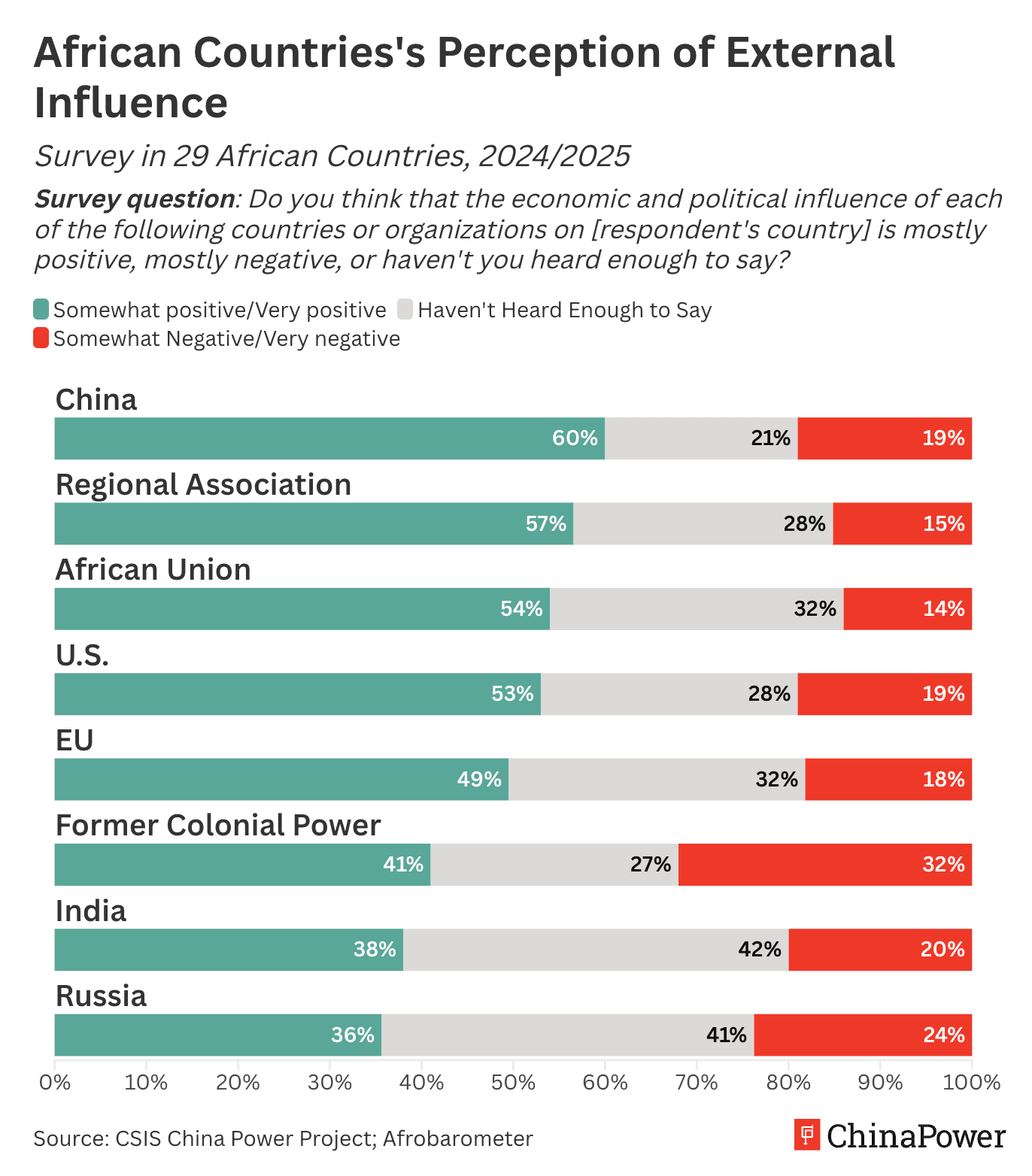
Source: CSIS China Power Project; Afrobarometer; ChinaPower
Additionally, there has also been an incentive to push out the West in African nations. As of January 2025, six African countries have cut military ties with France. China is pushing the narrative that the United States will exploit African nations. Anything the United States does to undermine African nations only supports this narrative.
Beijing’s approach is proving effective. African leaders seem to prefer this form of investment over the U.S. approach. In recent years, China has exceeded the United States in investment flow into Africa.
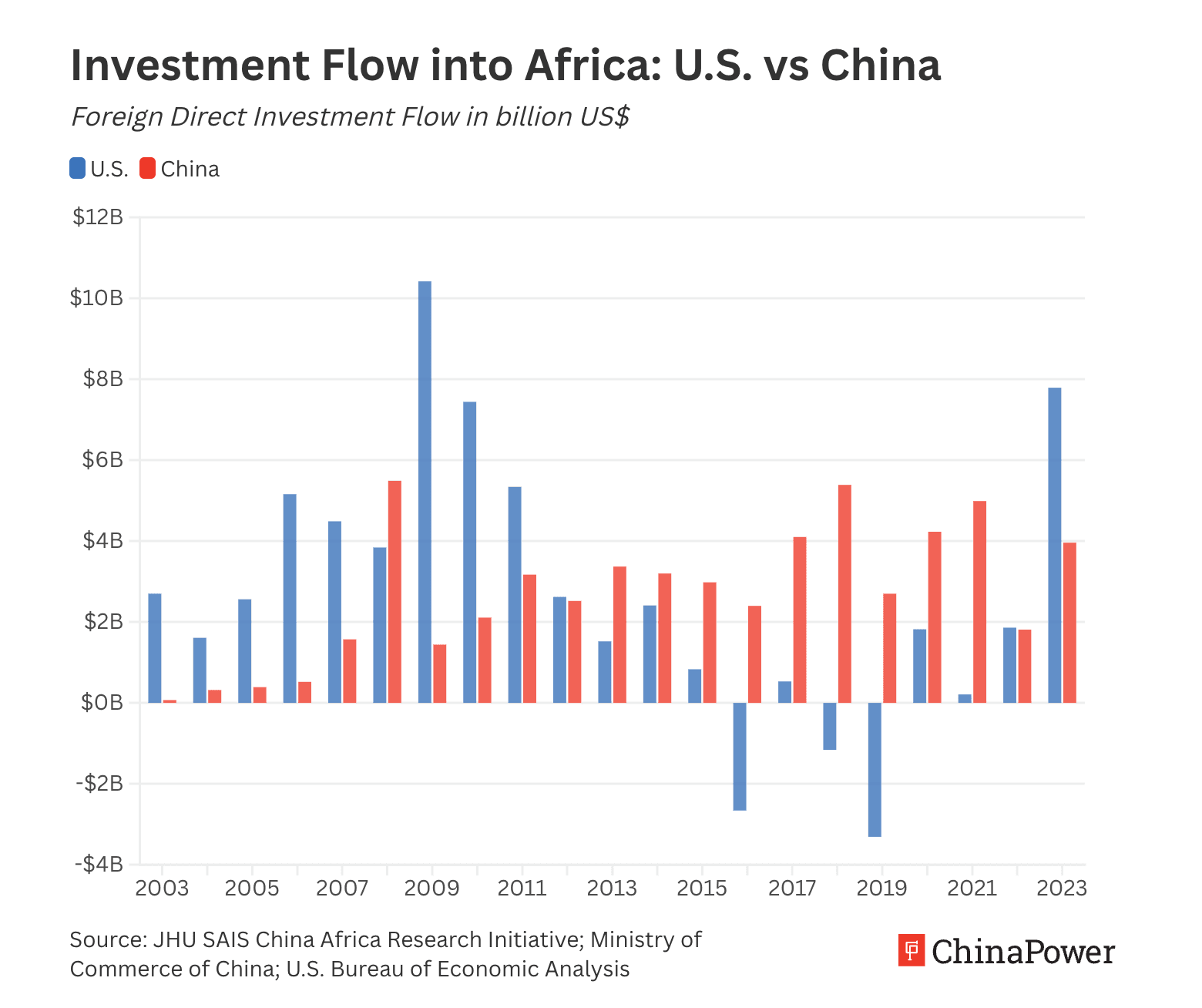
Source: JHU SAIS China Africa Research Initiative; Ministry of Commerce; ChinaPower
While the prevailing foreign policy of modern African leadership is one of strict strategic non-alignment, its neutrality cannot withstand the United States’ administrative withdrawal. By dismantling development frameworks like USAID and leaving critical ambassadorial posts vacant, the United States effectively removes itself as a viable partner. As African nations are forced to rely on Chinese infrastructure, the U.S. surrenders influence and ensures that China secures preferential access to cobalt, copper, and lithium, choking American supply chains and inflating the cost of everyday consumer technologies. The vast majority of smartphones, for example, require tantalum ore for their capacitors, and 70% of tantalum is sourced from Africa.
To regain its economic edge and secure its future, Washington must realize that investment in foreign aid is not simply a charitable donation, but rather a tool used to strengthen political ties and form important alliances.
Dismantling USAID affects both foreign and domestic affairs
Aside from forming a positive relationship with Africa, USAID has developed our agricultural sector and ensured it remains an important part of the United States economy.
Dismantling USAID puts 200,000 jobs on the line and takes away $23 billion in agricultural exports. This $23 billion isn't just used for crops delivered for foreign assistance, but also on agricultural research and development. According to Julian M. Alston of the University of California, Davis, the average cost-benefit ratio of agricultural research and development is 27.9 to 1. Every dollar invested is reimbursed through higher yields, lower farming costs, and more affordable consumer prices. Indirect investment in these industries by USAID is needed to combat increasing demand and a warmer climate.
To combat a $23 billion industry shortfall, the Trump administration has recently announced an $11 billion Farmer Bridge assistance program to give cash flow relief to domestic row-crop producers. Rather than merely patching this deficit with government assistance, Washington could deliver more sustainable support to row-crop producers by directly purchasing their commodities for global humanitarian relief.
Foreign assistance programs produce valuable trading partners. By supporting democracy and bolstering recipient countries’ economies, the U.S. can support the development of these viable trading partners, including African nations. Japan and South Korea, some of our largest trading partners, were once recipients of U.S. aid. Foreign assistance functions as a competitive tool to maintain our sphere of influence and can help stabilize emerging economies, such as the African nations of Rwanda, Ethiopia, and Ghana, and transform these rapidly expanding recipient countries into reliable trading partners. By dismantling foreign aid, we are not only harming our domestic agricultural economy, but we are also potentially hurting our trade relations with African nations. Projecting soft power also ensures that foreign countries, such as China, do not monopolize resources and sell goods to Americans at inflated prices.
Historical Precedents and the Fragility of Modern Power
The concept of a “cold war” is not exclusive to the 20th-century conflict between the United States and the Soviet Union. Historically, the Peloponnesian War similarly relied on proxy conflicts between Athens and Sparta, establishing a precedent for modern geopolitical standoffs. The Peloponnesian War gave rise to what is now known as the Thucydides trap, the theory of the increasing risk of war that emerges when an emerging power threatens to replace a ruling power. It has been used to parallel the 20th-century Cold War to the conflict that developed between Athens and Sparta. In both cases, the conflict was between two global superpowers, and citizens believed that the conflict would end in world destruction. The Thucydides trap indicates that patterns from the past are likely to recur in the present.
Consequently, we may understand the dynamics of this modern standoff by examining its 20th-century predecessor, as well as why repeating such a victory is growing doubtful. The first Cold War oversaw the political and ideological rivalry between the U.S. and the Soviet Union. Notably, it was one of the few major power conflicts within the last five centuries that did not result in direct war. The lack of direct military conflict, however, did not indicate peace; military spending due to proxy wars picked up in the 1980s and reached over 6% of GDP in the United States and a ruinous 15% in the Soviet Union. Ultimately, America prevailed over the Soviet Union by cultivating a network of alliances and investing in economic reconstruction. Programs such as the Marshall Plan strengthened Western Europe, limited the expansion of soviet influence, and demonstrated that foreign assistance could serve as a powerful strategic tool alongside military deterrence.
However, U.S. dominance in the ongoing conflict might not be as easily achieved, considering its diminished geopolitical stance. The economic leverage of U.S. sanctions is weakening because the global economic footprint of the U.S. and its allies is shrinking. Simultaneously, it highlights a systemic structural strain in geopolitics caused by a rising superpower, China, challenging a dominant superpower, the United States. In terms of GDP purchasing power parity, China has surpassed the United States as the largest economic power as of 2017. The imbalance of power is simply not tilted as favourably towards the U.S. anymore. The issue, however, is not that China will reach economic parity with the U.S, but that it could translate its growing economic strength into a greater geopolitical influence, as America’s alliances — and with them its global leadership — may gradually deteriorate, just as the Soviet Union’s alliances and global leadership once did.
Looking forward
The United States’ increasing emphasis on economic nationalism over global institutionalism mirrors the fallacy of previous empires. Like ancient Rome and feudal Japan, Washington risks overlooking a fundamental truth: for global dominance, focusing solely on domestic interests is counterintuitive; investment in international cooperation is also necessary for our survival, as no nation is entirely self-sufficient. Laying strength comes not only from investing in ourselves but from investing in the stability and prosperity of our allies.
As the U.S. competes with China for global influence, the question is not which country possesses greater economic or military power, but which one proves to be the more reliable partner. If the U.S. chooses to make short-term extractive trade deals at the expense of millions of lives while China continues to invest in long-term infrastructure, many recipient nations will eventually pick the latter over the former.
In every fight for global dominance lost, in any empire fallen, the first sign of decline is losing influence due to neglecting the relationships that once sustained its position. It happened to the Soviet Union during the Cold War. It happened to Rome as it failed to manage people beyond its borders. If American foreign policy continues to undervalue the benefit of foreign assistance, the U.S. risks the gradual erosion of the alliances that have long underpinned its global leadership.
But that outcome is not inevitable.
If we redirect our foreign policy towards uplifting our neighbors, helping their economies, and keeping America’s alliances strong, then we can restore our stance as global leaders. If just a one percent investment of the federal budget, spent on foreign aid, holds such a profound impact on U.S. global perception, imagine the impact of restoring that investment – or even doubling it to two percent. Such a commitment would not simply fund humanitarian programs; it would reinforce alliances and expand American influence abroad.
The decisions Congress makes today will help determine not only how the world views the United States, but also whether future generations inherit a nation that continues to shape the international order or one that merely reacts to it. The cost of engagement is small compared to the cost of rebuilding influence once it has been lost.
The views expressed in this piece are those of the author and do not necessarily represent the position of the Alliance 4 American Leadership (A4AL) alone. Alliance 4 American Leadership would like to acknowledge the many generous supporters who make our work possible.



Stay Updated
Become a member to learn about our impact, events, and how to get involved.