






Before 9:00 am on the morning of August 26th, a glacier collapsed high in the Himalayas. The wall of water, mud, and rock that followed tore through the Lhende Khola valley, destroying more than 20 bridges and wiping out some 25 miles of road. Nepal’s foreign minister did not call it a flood. He called it a “Himalayan tsunami”: waves 60-100 feet high moving at highway speed, “a scale of disaster that is entirely outside the living memory of Nepal.”
The numbers have only grown worse since. As of mid-September, roughly 1,400 people are dead and more than 6,000 are still missing across Nepal and Tibet including an estimated 85 Americans. Whole villages are gone. Hundreds of hydropower workers were trapped in tunnels. In one district, the remains recovered downstream outnumbered the morgues that could hold them, and officials were forced to bury the unidentified to prevent disease. Nepal’s finance minister estimates the country will need $4 to $6 billion to rebuild — close to a tenth of its entire economy.
Nepal asked the world for specific help: high-capacity drones, Bailey bridges to reopen severed valleys, DNA kits to identify the dead, tunnel-rescue suits, supplies to head off epidemics. This was not a request for charity. It was a request for the kind of technical muscle that, until very recently, the United States was unrivaled at providing.
The paltry response
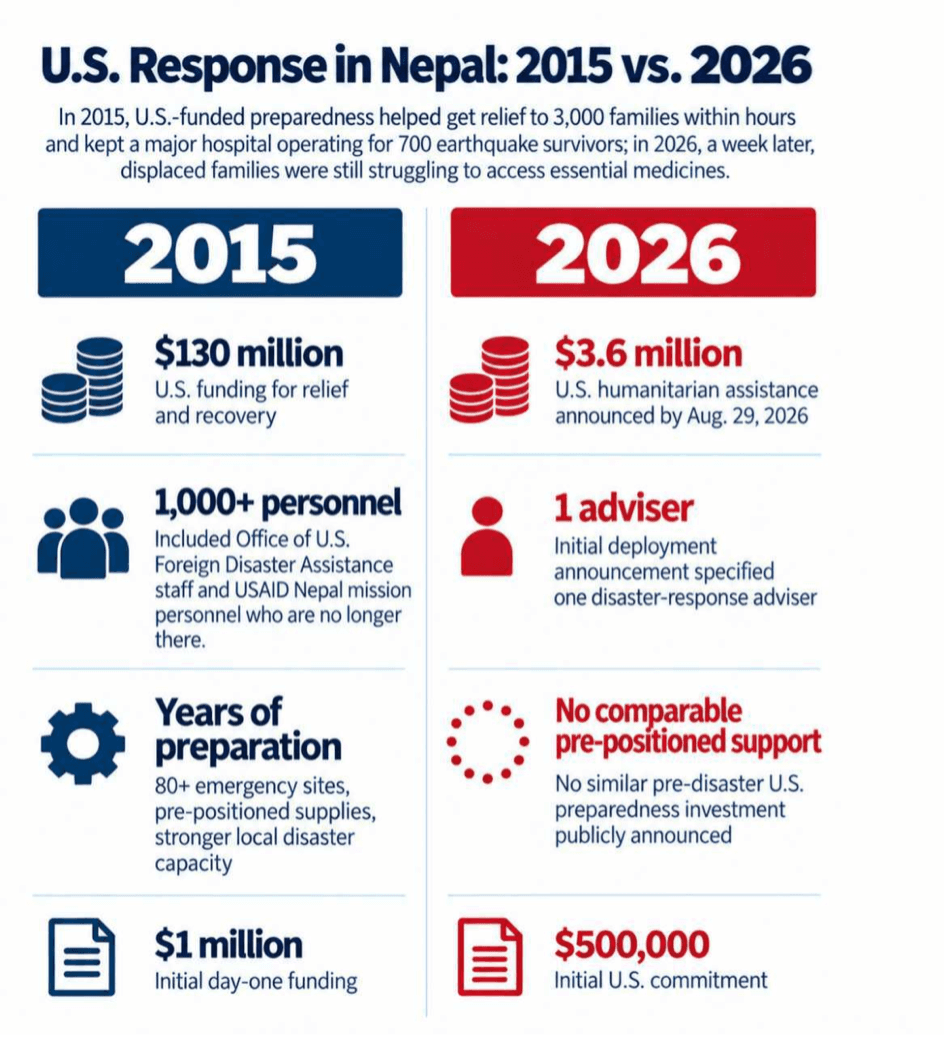
Here is what America offered: an initial $500,000 routed through Catholic Relief Services, a total of $3.6 million in humanitarian assistance, and one disaster-response adviser.
One adviser.
To see how far that falls short, you don’t need to look at our generosity in the past. You only need to compare us to our fellow nations today. The United Kingdom, an economy roughly one-eighth the size of ours, pledged almost $7 million—nearly double the American commitment in real terms and vastly larger relative to the size of its budget. Australia gave about the same amount we did, but their economy is roughly one-sixteenth of ours; they also sent personnel. The European Union offered $2.37 million, a regional coordinator, and satellite mapping. India sent physical relief: at least 62 metric tons of medicine, food, and supplies.
The United States, the largest economy on earth, was outmatched by allies many times smaller. We announced no comparable in-kind support, no airlift, no engineering teams. For a country that once defined what disaster leadership looked like, we barely showed up.
Source: M. Lindsey Kaplan, Ph.D.
How the United States used to help
We know exactly what a real American response looks like, because we have done it—in the very country of Nepal.
In April 2015, a magnitude 7.8 earthquake killed nearly 9,000 people in the country and caused $6 billion in damage. The United States committed $130 million to the relief effort, roughly thirty-six times this year’s figure. And the money was only part of it. USAID’s Office of Foreign Disaster Assistance deployed full Disaster Assistance Response Teams (DARTs), staffing them with trained urban search-and-rescue crews from Los Angeles County and Fairfax, Virginia. U.S. Pacific Command flew those teams and their equipment into mountain terrain that ground transport could never reach. American helicopters, logistics, and communications became the backbone of the relief effort. USAID went on to build a flagship disaster-preparedness program in Nepal called Tayar, which ran until it was discontinued in 2024.
That pattern repeated across the globe repeatedly because it worked. When catastrophic monsoon floods displaced 33 million people in Pakistan in 2022, USAID deployed a DART and, with the Defense Department, stood up an air bridge that moved nearly 630 metric tons of relief supplies, following with $16.4 million to help communities rebuild. In Nigeria, USAID put nearly $100 million toward flood relief and disaster readiness in a single fiscal year. In Burundi, it delivered emergency aid within weeks of El Niño flooding and funded the treatment of tens of thousands of malnourished children.
This was never simple generosity. Each of these operations bought the United States something no aircraft carrier can: the trust of a nation in its worst hour and the standing that comes from being the country that arrives right after the crisis comes. That is soft power in its most concrete form: a precious national-security asset.
What changed and what we lost
The reason the 2026 response looks nothing like the 2015 response is not a mystery. It is policy.
Following the 2025 dismantling of USAID, U.S. assistance to Nepal fell from roughly $212 million in FY2024 to about $56 million in FY2025. More broadly, over 98 percent of USAID’s climate- and resilience-related awards were terminated: $2.1 billion across 147 programs. The programs that vanished were early-warning systems, hazard monitoring, emergency training, and the institutional support that helps a vulnerable country see a disaster coming and coordinate when it arrives.
No one can say those cuts caused the glacier to collapse. But they hollowed out precisely the capabilities that save lives when it does: both Nepal’s, and our own ability to help. When you dismantle the machine, it comes as no surprise when it doesn’t run when needed.
The path forward
Public money deserves oversight; programs should be measured and optimized wherever possible. But oversight and abandonment are not the same thing, and reform and retreat are not the same thing. We do not have to choose between accountability and leadership. We can have both, and we used to.
Three things would put America back where it belongs.
First, in the immediate term, match the moment. At a minimum, restore disaster-relief funding and infrastructure to pre-dismantlement scale, and send a full DART team to Nepal rather than a lone adviser. The $130 million we committed in 2015 is the honest benchmark for what serious help costs.
Second, invest before the disaster, not just after it. The UN’s disaster-risk agency estimates that every dollar spent on preparedness saves four to seven dollars in response. Congress should establish predictable, multi-year funding for the unglamorous work that actually prevents catastrophe: early-warning systems, resilient infrastructure, and the capacity of local governments to act.
Third, build to hand off. The most durable aid strengthens local institutions until they can stand on their own: funding tied to measurable results, paired with real monitoring, and designed so that recipient nations grow self-sufficient rather than dependent. That is smarter, cheaper, and more sustainable than emergency checks written after the fact.
There is no need to reinvent the wheel. America already built the model that made it the world’s indispensable responder. The tragedy in Nepal is a reminder of the human cost of getting this wrong: 1,400 lives and counting, including more than 80 Americans. It is also a reminder of how much harm we can prevent when we get it right.
We already know how to be the country that shows up for our fellow nations. If we’re smart, we can be that country again.
The views expressed in this piece are those of the author and do not necessarily represent the position of the Alliance 4 American Leadership (A4AL) alone. Alliance 4 American Leadership would like to acknowledge the many generous supporters who make our work possible.


Stay Updated
Become a member to learn about our impact, events, and how to get involved.