




After five hours in a helicopter, I arrived in Mbandaka, a city on the Congo River in Equateur Province in the Democratic Republic of the Congo. We took boats upriver as part of fieldwork connected to an education project. When we landed, an elderly man walked up to me, grinning, shook my hand, and asked, “Do you know John?” I didn’t. John, he explained, had been a Peace Corps volunteer who taught him biology years before.
USAID was working in education in Equateur, too. On that same trip I visited a teacher resource center and library, and I remember noticing the foundation block marking the year USAID had built it. The building was still standing and still maintained. The books were there and being used. Students, teachers, and neighbors were coming through the doors.
That is what development looks like when it is working: a biology lesson a man still remembers decades later and a library that outlasts the people who built it. It runs on a long clock: longer than any one administration, ambassador, or political appointee. And that is exactly why what happened to USAID in 2025 should trouble anyone who cares about American influence in the world.
When I first served overseas, as a Peace Corps volunteer in Africa, and later as a Senior English Language Fellow with the State Department, I didn’t really understand what USAID did. I learned the agency the way most people in the field do: by seeing its work directly and meeting the people it reached.
Later, inside the system, I learned something else—how carefully the relationship between development and diplomacy had been built. Before its dismantling, by law USAID was its own agency. Its Administrator took foreign-policy guidance from the Secretary of State, who was responsible for coordinating U.S. assistance and resolving disputes among agencies, but USAID remained separate, with its own leadership and its own appropriation. When President Clinton reorganized foreign affairs in December 1998, he chose to keep it that way.
Why does that structure matter? Because it gave development an institutional voice of its own. Let me show you what that looked like in practice.
I saw it while serving with USAID in Myanmar. I was receiving weekly reports of schools bombed by the military. Our implementing partner documented who was killed, who was injured, and what had been destroyed. One ethnic armed organization wanted to make a formal commitment to protect schools from the fighting, and asked USAID to speak at the event. Our acting USAID Mission Director agreed that we should seek permission. We did.
The Chief of Mission, the U.S. Ambassador, who holds authority over everyone at post, USAID staff included, decided that I would not speak, and that the embassy would issue no statement. We followed that decision at post without question.
But the story did not end there. USAID’s leadership in Washington, including the Administrator, had been kept abreast of the continuing airstrikes against schools, health centers, and places of worship. And from Washington, the agency released its own statement condemning the attacks and calling for them to stop immediately. The Ambassador controlled what we did at post. USAID, as a separate agency, still had a voice beyond that decision. That is the friction the system was built to allow, and it is the vital independence we just gave away.
This debate is not new. In January 2010, Hillary Clinton argued that diplomacy, defense, and development needed to work more closely together. She acknowledged the worry that integration could mean “diluting it or politicizing it,” or “giving up our long-term development goals to achieve short-term objectives.” She pledged not to let that happen and called the experience and technical knowledge of development professionals “absolutely irreplaceable.” Fifteen years later, we are finding out what happens when you treat it as replaceable after all.
On January 20, 2025, President Trump ordered a 90-day pause and review of foreign development assistance. On March 28, the State Department notified Congress that it intended to move selected USAID functions into the Department. State assumed those functions on July 1, 2025.
The warnings came quickly. In May 2025, USAID’s own Inspector General told Congress about the “loss of institutional expertise,” noting that by one estimate roughly 70 percent of USAID’s staff were highly specialized: medical doctors, engineers, water and sanitation specialists. Rebuilding that at State, the IG said, would take significant time and resources.
A State Department Inspector General evaluation in July 2026 showed how the handoff was actually going. By September 2025, 17 State bureaus and offices were administering 1,504 programs and awards transferred from USAID, with $51.5 billion obligated. Five of the sixteen offices that answered the IG’s questionnaire said they had no prior experience managing foreign assistance at all. On September 30, 2025, 113 transferred awards had no responsible bureau even listed. African Affairs had requested 732 positions to carry the load: it received 232.
Part of the problem was structural. State had always managed its awards centrally, from headquarters, with support from posts. USAID had done it out in the field, at regional hubs and individual posts, close to the work. You cannot simply pour one into the other. Offices ended up short on staff and training, some without access to the systems they needed, working from unclear guidance and bad data. And without the vital resource of the over 10,000 highly skilled USAID staff who were cut from their positions.
And as the machinery broke down, something else crept in. In May 2025, Ambassador Michael Gonzales announced that the United States would cut $50 million a year in medicine support for Zambia, citing a U.S. investigation that had found U.S.-donated drugs for sale in nearly half of more than 2,000 pharmacies. Fair enough, on its face. But Reuters reviewed the proposed replacement — a health agreement worth more than $1 billion, with Zambia contributing about $340 million over five years — and found a catch: U.S. funding could end if the two governments failed to reach a separate bilateral compact. Three people familiar with the talks said that compact involved mining cooperation. Zambia denied any link, insisting the health deal had “no relation whatsoever to minerals, mining, or any natural resources.” Gonzales later called the accusation “disgusting and patently false.” Days after that, Zambia’s foreign minister said his government wanted the health and minerals agreements considered separately.
Here is the crucial distinction. Asking Zambia to pay more of its own health costs over time is good development: it is exactly how a country is meant to move toward independence. Tying lifesaving health services to concessions in the mining sector is something else. In my view, it is transactional diplomacy under the cover of foreign assistance.
South Africa told the same story. On June 2, 2026, Secretary of State Marco Rubio told the Senate Foreign Relations Committee, “The U.S. government is not a charity,” and “We are here to win.” Weeks later, Semafor reported that the administration planned to phase out PEPFAR funding in South Africa, citing demands that the country reduce its ties with Iran, end its Black Economic Empowerment policies, and address the “Kill the Boer” chant. This was PEPFAR: the program that in fiscal year 2024 alone supported treatment for more than two million South Africans living with HIV, 97 percent of whom were virally suppressed keeping the epidemic under control, and that had been paying some 15,000 health workers’ salaries. The administration’s answer was that South Africa could pay for its own.

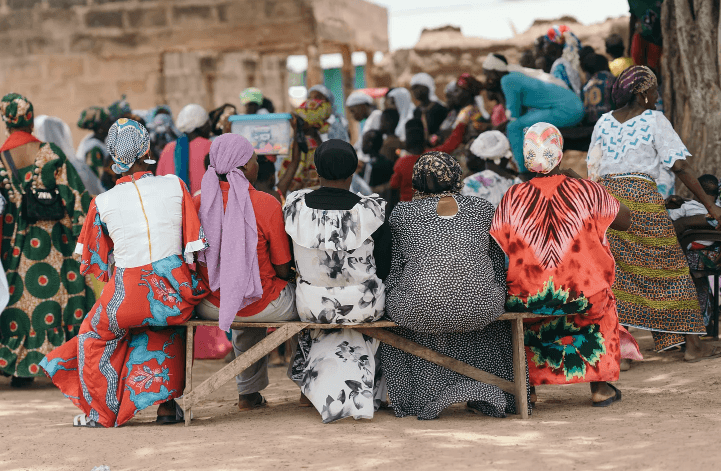
Participants at a USAID Zambia Integrated Health event, supported through PEPFAR, in Zambia.
USAID was never outside presidential authority. But development works on a longer clock than politics. Programs were built to outlast an administration, ambassadors, and rafts of political appointees. It was the agency’s career staff and program systems that carried that work across those changes. Remove them, and you don’t just lose a budget line: you lose the memory.
I watched us lose it. In the summer of 2025, I was serving as the Education Team Lead for USAID Burma, based in Bangkok, under the authority of the U.S. Embassy Myanmar and the Chief of Mission. The mission received notice: come in, return your badges and radios, pick up a letter from the ambassador, and leave for the last time. The Foreign Service Nationals (local citizens of the host country working for USAID) lined up, along with the Americans still there, some leaving that day, others within a few weeks.
As I walked through the offices one last time, I thought about the memories we had collected along the way: the work we did, the anticipation only months earlier about the new administration, the people we had made promises to and stood beside for decades and then abandoned without so much as the chance to say goodbye. I thought about the people in that line. The FSNs, some of whom had worked with the U.S. government for decades, had given up other careers to serve on behalf of the American people. By affiliation alone, they could now be targeted, investigated, possibly imprisoned.
The Americans who served with USAID overseas were used to both the joys but also the hardships of expat life: missing family birthdays, weddings, and moments they could never get back, because they chose to serve, sometimes in places of conflict or disaster.
I think about my own version of that. At the start of COVID, I was offered authorized departure. I said no. I stayed so that someone would be in my office to support staff and keep the work going. It was a hard decision, but at that moment I felt I had a duty to stay, and I did. I knew then that I had a sick parent. I didn’t know how sick until some years later, when I was rushing home from another post overseas, only to arrive a few hours after they had died. I will forever regret that moment.
All of it flashed by as the line to depart my USAID mission got shorter and shorter, and I returned my things, picked up my exit slip and my badge, and rode the elevator down for the last time.
It became clear to all of us that this was not a normal presidential transition. It was not about efficiency. It was an ideological hit job: driven by DOGE, led by the billionaire Elon Musk, and executed by very young engineers, including a 19-year-old with no government experience who was issued a usaid.gov email address. Nearly 60 senior career officials across USAID’s Washington bureaus were placed on administrative leave within the first week; much of the agency’s senior leadership was decapitated almost overnight. The Secretary of State, who had once praised USAID’s work and defended foreign assistance, allowed our development and humanitarian public servants to be lied about and their reputations tarnished. And one of the country’s largest digital public squares happened to be owned by the very man leading the effort to dismantle it: Musk used his platform to flood that space with false claims, calling USAID “evil” and a “criminal organization.”
After 60 years of following orders, working within a chain of command, and doing what was asked of them, many of us did not know how to react when the institution itself came under assault.
Here is what I keep coming back to. Development needs a separate professional home within a larger foreign policy. It is the third pillar. A diplomat with the State Department is building relations and considering political leverage; a development worker, a humanitarian, is out in the field. That friction is not a flaw. It is healthy for discourse and for decisions.
As our country debates the value of foreign assistance and rebuilds what it should look like, maybe the real question is simpler than the budget fights make it sound: are we good enough, and generous enough, to help people because it is just the right thing to do, for our own strength and the welfare of the world—without turning that help into leverage for unrelated concessions?
I wonder if they’ll ever let us return.
Postscript: What Congress Can Restore
Congress wrote the framework into law back in 1998, and it can restore it. In plain terms: USAID should be put back as a functioning, separate agency, with a Senate-confirmed Administrator who answers to the Secretary of State on foreign policy, and with its overseas staff under the authority of each Chief of Mission at post. Congress should protect the technical specialists the Inspector General warned we were losing—the doctors, engineers, and water and sanitation experts. And it should prohibit what we have begun to see: conditioning lifesaving health assistance on unrelated commercial or mineral concessions.
References
Scenes in the DRC and Myanmar, the mission closure and the account of the author’s family are drawn from the author’s own experience.
U.S. House of Representatives, Office of the Law Revision Counsel. 22 U.S.C. §§ 6592–6593, provisions governing the USAID Administrator’s relationship with the Secretary of State and foreign-assistance coordination. Also 22 U.S.C. §3927, Chief of Mission. Also 22 U.S.C. §6563, Status of AID.
U.S. Agency for International Development. “USAID Condemns Attacks on Schools in Myanmar,” September 2024, as contemporaneously reproduced by Mizzima, September 24, 2024.
Clinton, Hillary Rodham. “Remarks on Development in the 21st Century.” U.S. Department of State, January 6, 2010.
White House. Executive Order 14169, “Reevaluating and Realigning United States Foreign Aid.” January 20, 2025.
U.S. Department of State. “Congressional Notification Transmittal Letter.” March 28, 2025.
U.S. Agency for International Development, Office of Inspector General. “USAID OIG’s Appropriations Response on Identification of Key Questions, Policies, Procedures, and Statutes in USAID’s Realignment to the State Department.” May 2025.
U.S. Department of State, Office of Inspector General. Evaluation of Department of State Administration of Foreign Assistance Programs Transferred from the U.S. Agency for International Development. AUD-FA-26-17. July 2026.
Sichalwe, Noel. “US Says It Will Reduce Health Aid to Zambia Because Medicines Were Stolen and Sold.” Associated Press, May 8, 2025.
Rigby, Jennifer, Chris Mfula, and Olivia Kumwenda-Mtambo. “Zambia Pushed Back on U.S. Health Funding Deal to Protect Interests, Government Says.” Reuters, February 25, 2026, updated February 26, 2026.
Reuters. “US Criticises Zambia for Lack of Engagement as $1 Billion Health Deal Stalls.” May 1, 2026.
Reuters. “Zambia Says US Health Deal Must Be Uncoupled from Minerals Access.” May 4, 2026.
Rubio, Marco. “Statement Before the Senate Committee on Foreign Relations.” June 2, 2026.
Elimian, Adrian, and Nicholas Wu. “Trump Administration to End PEPFAR Funding for South Africa.” Semafor, June 18, 2026.
Brunnstrom, David. “UNAIDS Chief Urges US to Reconsider South Africa Funding Cut.” Reuters, June 22, 2026.
Centers for Disease Control and Prevention. “HIV and TB Overview: South Africa.” June 30, 2025.
Psaledakis, Daphne, Humeyra Pamuk, and Simon Lewis. “Trump Administration Targets Dozens of Senior USAID Staff After Aid Freeze.” Reuters, January 28, 2025.
DiMolfetta, David, and Alexandra Kelley. “DOGE Deputies Land at State Department Tech Bureau with USAID Emails.” Nextgov/FCW, February 10, 2025.
Zadrozny, Brandy, and Lora Kolodny. “How Elon Musk Boosted False USAID Conspiracy Theories to Shut Down Global Aid.” NBC News/CNBC, February 7, 2025.
Sherman, Amy, Claire Cranford, and Louis Jacobson. “Marco Rubio Supported USAID as a Senator. As Secretary of State, He Backs Gutting It.” PolitiFact, February 7, 2025.
The views expressed in this piece are those of the author and do not necessarily represent the position of the Alliance 4 American Leadership (A4AL) alone. Alliance 4 American Leadership would like to acknowledge the many generous supporters who make our work possible.



Stay Updated
Become a member to learn about our impact, events, and how to get involved.